



Welcome back to SAT Saturday!

Now that we have locked down linear relationships, it is time to scale up. Today, we are stepping into the arena of Advanced Math, which accounts for roughly 35% of your total SAT Math score.
While linear models represent quantities that change by a constant amount over time, exponential models represent quantities that change by a constant percentage over time. This includes population growth, compound interest, and radioactive decay.
The College Board tests exponential equations in two distinct ways: checking if you understand what the percentage multiplier actually represents, and throwing tricky time-intervals at you to see if your exponent rules hold up.
Let’s dive in, check our algebraic foundations, and master the curves of exponential modeling!
A wildlife biologist monitors the population of a specific bird species in a state park. The model below estimates the population, P, of the bird species t years after the initial observation.


Which of the following statements is the best interpretation of the number 1.045 in this context?
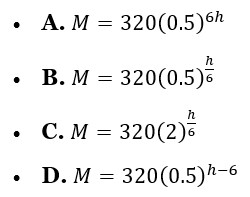
A technician places a sample of a certain radioactive isotope into a secure chamber. The mass of the sample, in grams, decreases exponentially over time. The sample loses half of its mass every 6 hours. If the initial mass of the sample is 320 grams, which equation models the mass, , in grams, remaining after hours?
Let’s check your work from last week’s linear algebra challenges!
The Problem: A local solar energy company installs rooftop solar panels. The total cost, y, in dollars, for a customer to have solar panels installed and maintained for x months is modeled by the equation:
y = 125x + 3800
What is the best interpretation of 3,800 in this context?
🧭 The SAT Concept: Slope-Intercept Structure
The Digital SAT regularly tests whether you understand the structural components of the slope-intercept formula: y = mx + b
The Problem: An online bookstore charges a flat shipping fee per order plus a fixed price for each paperback novel purchased. An order of 4 paperback novels costs a total of $31.00. An order of 7 paperback novels costs a total of $49.00. Which equation represents the total cost, C, in dollars, for an order of n paperback novels?
📐 The Mathematical Proof
Now, calculate the slope (the rate per book):
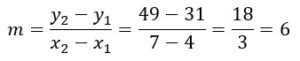
Since each paperback book costs $6, our slope must be 6. This instantly eliminates options B, C, and D!
C = 6n + b
31 = 6(4) + b
31 = 24 + b
b = 7
The flat shipping fee is $7, yielding our final linear equation: C = 6n + 7
When students hit high school and begin prepping for college admissions, the transition to Advanced Math topics like exponential systems and coordinate geometry can feel overwhelming. Many students fall into the trap of trying to memorize dozens of disconnected formulas, which leads to testing anxiety and simple calculation errors.
 At MyTutorLesson, we do things differently. We break complex algebra, statistics, and advanced functions down into intuitive, visual concepts. By reinforcing core structural relationships and showing students the practical “why” behind the math, we build independent problem-solvers who can confidently tackle any challenge the SAT or high school curriculum throws at them.