



If there is one topic in elementary mathematics that consistently strikes fear into the hearts of fourth and fifth graders, it is long division.

Up until this point, division felt manageable. Students could rely on their basic multiplication facts backwards, or draw simple circles and groups to find an answer. But suddenly, they are hit with a long, vertical bracket, large 3-digit numbers, and a rigid, multi-step sequence that feels like a grueling memory test.
It is completely normal for students to hit a wall here. Long division isn’t difficult because the math itself is hard; it is difficult because it requires an intense amount of executive function. A student has to track where they are in a loop, keep their vertical place-value columns perfectly straight, and perform three different mathematical operations all in one problem.
The secret to conquering long division is slowing down, focusing on clean spatial organization, and practicing with clean, satisfying numbers that have no remainders.
Let’s break down the exact family-friendly system we use at MyTutorLesson to turn long division into a simple, predictable game!
To help students remember the exact order of operations, math teachers love using a simple, classic acronym memory trick: Does Macaroni Smell Bad? (Or, Dad, Mom, Sister, Brother).
Each letter stands for a vital step in the division cycle:
Look at the very first digit inside the bracket. Can the it be divided by the divisor (the number on the outside)? If it can, write the missing factor above that first number.
If it can’t, then look at the first two numbers as a two-digit number and decide if that can be divided by the divisor. If it can, write the missing factor above the second number.
Multiply the “missing factor” that you wrote above by the divisor and write the result below the first (or first two) digit(s).
Subtract the multiplicand (what you multiplied together) from the first digit(s) in the dividend (under the bracket). Write your answer below.
Draw an arrow and bring down the next number from the dividend.
Once you finish step 4, you simply loop right back to the top and repeat the family cycle until there are no numbers left to bring down!
A Step-by-Step Worked Example:
Let’s walk through a clean example together. We want to find how many times 4 goes into 364. We write it with 4 on the outside of the division bracket (the divisor) and 364 on the inside (the dividend).
The First Loop:
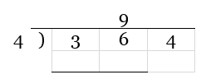 Step 1: Divide (D) – Look at the very first digit inside the bracket. Can 4 go into 3? No, 3 is too small. So, expand your view to the first two digits. How many times does 4 go into 36? Exactly 9 times. Write the directly on top of the bracket, right above the .
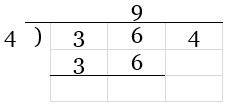 Step 2: Multiply (M) – Multiply that new on top by the on the outside: . Write directly underneath the 36 inside the bracket.
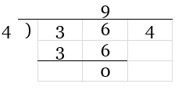 Step 3: Subtract (S) – Draw a line and subtract:.
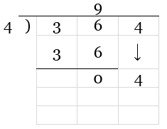 Step 4: Bring Down (B) – Look to the next number inside the bracket, which is the . Draw a long arrow and bring that straight down next to your .
The Second Loop:
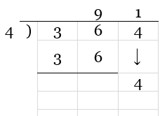 Step 1: Divide (D) – Now we look at our new bottom number: . How many times does 4 go into 4? Exactly 1 time. Write the on top of the bracket, right above the last 4.
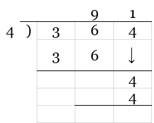 Step 2: Multiply (M) – Multiply that new on top by the on the outside: . Write right below the bottom 4.
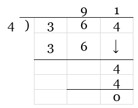 Step 3: Subtract (S) – Subtract: .
Our final answer sitting beautifully on top of the bracket is 91!
 Two Pro-Tips for Parents at Home
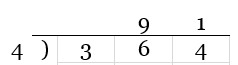
The number one reason students get long division questions wrong isn’t because they don’t know their facts — it’s because their handwriting drifts, and they accidentally subtract numbers from the wrong place-value column! Have your child practice long division on graph paper, writing exactly one digit per box. This acts as an automatic visual guardrail to keep their columns flawlessly straight.
Always encourage your student to check their work backwards using multiplication! In our example, they can verify their answer by calculating . If it equals , they instantly know they earned a 100% on the problem before they even hand it in.
Lock #1: 444 ÷ 6 = 74
Lock #2: 525 ÷ 5 = 105
Lock #3: 288 ÷ 3 = 96
Lock #4: 768 ÷ 8 = 96
Long division is a major transitional gateway in a student’s academic path. When a student struggles with this layout, it can rapidly erode their confidence and cause them to shut down when faced with multi-step pre-algebra systems down the road. But when they are given the spatial tools, the patience, and the structural clarity to master it, their entire perspective on math changes.
At MyTutorLesson, we specialize in breaking down intimidating academic walls into highly structured, achievable milestones. From building foundational kindergarten number sense to untangling advanced high school algebra and college-level courses, our interactive private tutoring sessions fill core conceptual gaps and replace test-day panic with genuine confidence.
Equip your child with the tools to master complex math.
Have questions about math habits, or want to share how your student liked the graph paper trick? Connect with our educational coaching team anytime at info@mytutorlesson.com!