

Use code NEWSTUDENT at checkout & save 20% off your first order (any number of lessons)
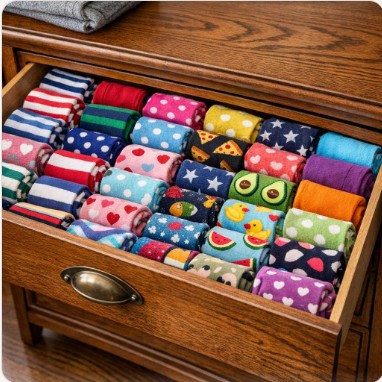
Math Teasers are meant for thinking outside of the box. They require more logical thinking than being a math whiz-kid. Today you are presented with the Sock Drawer Puzzle.
Your sock drawer contains
15 green socks and
15 blue socks.
Without looking, what is the smallest
number of socks you need to take out
to guarantee a matching pair?

If the first two don’t match, the third one will certainly match one of the first two.
These riddles, often called “pigeonhole principle” puzzles, focus on ensuring a result in a “worst-case scenario.” They require finding the minimum number of items to guarantee a match, similar to the 3-sock rule (two colors = three socks).

The Mixed Drawer: You have 10 red, 8 blue, 6 green, 4 orange, and 2 white socks in a dark drawer. How many must you pick to guarantee one matching pair? (Answer: 6, as you could pick one of each color, then the 6th must match).
Key logic: Always count the maximum number of socks you can pull without making a pair (one of each color), and then add one more.

Are you ready to challenge your math mind? Sign up for class(es) at MyTutorLesson – Math.