

Use code NEWSTUDENT at checkout & save 20% off your first order (any number of lessons)
Today’s fun puzzle is the Train Dilemma. This is a group of Algebra questions. You will need to use the distance formula.
distance = (rate)(time) or d = rt.
A train leaves Teenburgh at an average speed of 50 miles per hour and heads for Sunnyville. Another train leaves Sunnyville at an average speed of 40 miles per hour and heads for Teenburgh. If the route is 360 miles long, how many hours will it take for the 2 trains to meet?
The classic “meeting point” problem is a staple of algebra because it perfectly illustrates how relative speeds work. The secret sauce is that since they are moving toward each other, their speeds combine to close the gap.
ANSWER: It will take 4 hours for the 2 trains to meet.
Let’s first draw a picture to make the problem a little clearer.
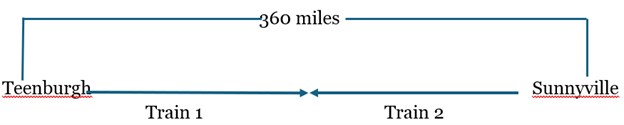
We notice from the picture that the distance traveled by Train 1 up until the moment the two trains meet added to the distance traveled by Train 2 up until the moment the two trains meet is equal to the total distance between the two cities.
Next we implement the distance formula:
d = rt (distance = rate ∙ time)
Train 1 : d = 50t
Train 2 : d = 40t.
Together, they are traveling the total distance of 360 miles.
50t + 40t = 360
90t = 360
t = 4 hours
ANSWER: It will take 4 hours for the 2 trains to meet.
In 4 hours, train 1 will have traveled 4 ∙ 50 = 200 miles and train 2 will have traveled 4 ∙ 40 = 160 miles.
Here are three more problems that use similar logic but add a little extra “flavor” to keep you on your toes.

The Scenario:
A freight train leaves Chicago for New York (800 miles away) traveling at 60 mph. Two hours later, an express train leaves New York for Chicago on a parallel track, traveling at 100 mph.
The Challenge:
How many hours after the express train leaves will the two trains pass each other?
Pro-tip: Figure out how much distance the first train covered during its 2-hour head start before you combine their speeds.

The Scenario:
A car thief leaves a gas station heading north at 70 mph. After 15 minutes, a police cruiser leaves the same station, chasing the thief at 95 mph.
The Challenge:
How long will it take for the police officer to catch up to the thief?
Pro-tip: In this case, the trains (cars) are moving in the same direction, so you subtract the speeds to find the “catch-up” rate. Also, watch your units—convert those 15 minutes into hours!
The Scenario:
A commuter train travels from City A to City B at an average speed of 40 mph. On the return trip, the train is lighter and travels the exact same route at 60 mph.
The Challenge:
What is the average speed for the entire round trip?
Warning: It’s almost never the simple average of the two numbers! Try picking a “fake” distance for the trip (like 120 miles) to help you calculate the total time spent traveling.
Let’s keep the momentum going! These next three introduce some common algebra “curveballs” — like varying departure times and using the speed of a medium (like water or wind).

The Scenario:
Two cyclists, Alex and Blair, are 120 miles apart. They begin cycling toward each other at the exact same time. Alex travels at 12 mph, and Blair travels at 18 mph.
The Challenge:
How far will Alex have traveled when they finally meet?
The Twist: This asks for distance, not just time. Once you find the time it takes for them to meet, you have to plug it back into Alex’s specific speed formula.
The Scenario:

A motorboat can travel at 20 mph in still water. It travels 60 miles downstream (with a 4 mph current) and then turns around to travel 60 miles back upstream (against that same 4 mph current).
The Challenge:
How much longer does the return trip take than the downstream trip?
The Logic: When going downstream, your speed is 20 + 4. When going upstream, your speed is 20 – 4.

The Scenario:
A hiker is lost and walking along a straight trail at 3 mph. Two hours after the hiker is reported lost, a rescue team starts from the same trailhead, moving at 5 mph to catch up.
The Challenge:
How many miles from the trailhead will the rescue team finally reach the hiker?
The Logic: This is another “Overtaking” problem. The hiker has a 6-mile head start (3 mph ∙ 2 hours). The rescue team “gains” on the hiker at a rate of 2 mph.
Train C (Chicago): d = 60t + 120
Train N (New York) : d = 100t
60t + 120 + 100t = 800
160t = 680
t = 4.25 hours
Thief: d = 70t + (.25)(70)
Police: d = 95t
95t = 70t + 17.5
25t = 17.5
t = 0.7 hours
To: d = 40t
From: d = 60t
120 = 40(3)
120 = 60(2)
240 = x(5)
x = 48 mph
Try with a different distance.
60 = 40(1.5)
60 = 60(1)
120 = x(2.5)
x = 48 mph
Alex: 12t
Blair: 18t
12t + 18t = 120
30t = 120
t = 4 hours
Alex: d = 12(4) = 48 miles
Downstream: 60 = (20 + 4)t
24t = 60
t = 2.5 hours
Upstream: 60 = (20 – 4)t
16t = 60
t = 3.75
3.75 – 2.5 = 1.25 hours more to go upstream than to go downstream.
Hiker: d = 3t + 2(3)
Rescue Team: d = 5t
5t = 3t + 6
2t = 6
t = 3 hours
After 3 hours, the search team and the hiker will have traveled 15 miles.
Since you’ve crushed the basics, here is one more that combines everything.

The Scenario: A messenger on a bicycle leaves a base camp heading for a relay station 20 miles away, traveling at 10 mph. Exactly 30 minutes later, a second messenger on a motorcycle leaves the same camp to deliver a forgotten map to the first messenger, traveling at 30 mph.
The Challenge: Does the motorcycle messenger catch the bicyclist before they reach the relay station? If so, how many miles from the station are they when they meet?
Bicyclist: 20 = 10t
It will take the bicyclist 2 hours to reach the relay station.
Motorcyclist: 20 = 30t
It would take the motorcyclist 2/3 hour – 40 minutes – to reach the relay station.
Since the motorcyclist left 30 minutes after the bicyclist, even if he had to go the whole way to the relay station it would be less than the time it took the bicyclist. (30 + 40) = 1 hour 10 minutes. Therefore, the answer to the first question is yes, the motorcyclist will catch up to the bicyclist before they reach the relay station.
Bicyclist: d = 10t + (10)(0.5)
Motorcyclist: d = 30t
30t = 10t + 5
20t = 5
t = 0.25 hours.
At t = 0.25 hours they will be 7.5 miles from the base and 12.5 miles from the relay station.
Congratulations on completing the Train Dilemma suite of questions.

Fridays we present more challenging math practice, most of them are Algebra or Geometry. When a formula is needed, it will be provided.
Do you have a question to ask the math teacher? Our math teacher, Mary Lou loves puzzles and riddles! Please send your request to info@mytutorlesson.com You just may see it posted here on a future date.