

Use code NEWSTUDENT at checkout & save 20% off your first order (any number of lessons)

SAT Saturday: Algebra & Linear Models

Monochrome photo of rulers and protractor on graph paper, emphasizing geometry.

SAT Saturday: Algebra & Linear Models

SAT Saturday: Algebra & Linear Functions Mastery

Welcome to Week #15 of SAT Saturday!
An open notebook with equations written in it and a calculator, pencil, and eraser on it.
Image by Dx21 from Pixabay
Algebra forms the core backbone of the SAT Math section — accounting for approximately 35% of all questions. This domain tests your ability to analyze, graph, and interpret linear equations, linear inequalities, and systems of equations in real-world contexts. To score high on the SAT, you don’t just need to calculate numbers; you must understand what the parameters (like slope and y-intercept) actually mean in word problems and graphs. Today, we are reviewing last week’s trigonometry solutions and tackling two high-frequency linear algebra concepts!

📝 Week #15 Practice Questions: Algebra & Linear Models

Question 29: Interpreting Linear Constants (High Frequency) A logistics company uses the equation C = 2.50x + 75 to calculate the total cost, C, in dollars, for a ground delivery shipment traveling x miles. Which statement is the best interpretation of the number 75 in this context?
  • A) The cost increase, in dollars, for each additional mile traveled.
  • B) The total number of miles the delivery truck can travel on a single trip.
  • C) The minimum or initial charge, in dollars, to set up and load the shipment.
  • D) The average speed of the delivery truck in miles per hour.

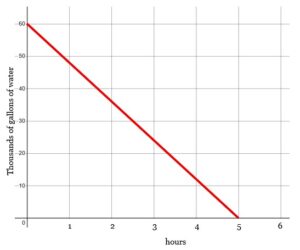
Question 30: Calculating Rates of Change from Graphs Scenario: A municipal maintenance crew is completely draining a commercial swimming pool to perform structural repairs. The linear graph models the volume of water, , in thousands of gallons, remaining in the pool  hours after the drainage pump is turned on. Graph for question 30 with points (0, 60) and (5, 0) easily identifiable. The x-axis is marked as hours and the y-axis is marked as Thousands of gallons of waters. Question: Based on the scenario and rate of change, at what constant rate, in thousands of gallons per hour, is the water being drained from the swimming pool?
  • A) 10
  • B) 12
  • C) 50
  • D) 60
(Write down your worked-out answers! The complete solutions will be revealed in next week’s SAT Saturday post.)

💡 Quick SAT Math Tip for Week #15

The Slope-Intercept Blueprint:

In any real-world linear equation (y = mx + b):

  •  m (Slope): Represents the rate of change per unit (words like per, each, every, hourly rate).
  •  b (y-intercept): Represents the initial value or starting amount (words like flat fee, deposit, starting balance, setup cost when x = 0).

🏆 Week #14 Answer Key & Detailed Explanations

Let’s review the step-by-step solutions for last week’s Geometry and Trigonometry questions.

In right triangle ABC, angle B is a right angle. If cos(A) = 5/13, what is the value of sin(C)?

  • A) 5/13
  • B) 12/13
  • C) 13/12
  • D) 12/5

Correct Answer: A)


The Concept:

This problem highlights one of the SAT’s favorite trigonometric identities:

sin (x°) = cos (90° – x°)


The Breakdown:

  1. In any right triangle, the two acute angles always sum to 90° (they are complementary). Because angle B is the  right angle, angles A and C must add up to 90°.
  2. The sine of one acute angle in a right triangle is always exactly equal to the cosine of the other acute angle. Why? Because the “opposite” side for angle C is the exact same physical side as the “adjacent” side for angle A.
  3. Therefore:

sin (C) = cos (A) = 5/13

No complex drawings or side-length calculations required!


Triangle JKL is similar to triangle XYZ, where vertices J, K, and L correspond to vertices X, Y, and Z, respectively. The measure of angle K is 90°, the length of side JK = 15, and the length of side KL = 8. What is the value of tan(Z)?


Correct Answer: 15/8 (or 1.875)


The Concept:

This problem tests two concepts at once: right-triangle ratios (tan Θ = opposite/adjacet) and similar triangle properties.


Step-by-Step Breakdown:

  1. Apply the Similar Triangles Rule: Similar triangles have proportional side lengths, but their corresponding angles are identical. Because the angles are identical, their trigonometric ratios (sin, cos, tan) are also identical.
  2. Since vertex L corresponds to vertex Z, we know that tan Z = tan L. We can do all of our work directly using triangle JKL!
  3. Apply SOH-CAH-TOA: Angle K is the 90° right angle, which means sides JK and KL are the legs. For angle L:
    • The side opposite to L is JK = 15.
    • The side adjacent to L is KL = 8.

tan (L) = opposite/adjacent = 15/8

Students can grid in the fraction 15/8 or the decimal equivalent 1.875.


Master the SAT Math Section with MyTutorLesson

Monochrome photo of rulers and protractor on graph paper, emphasizing geometry.
Image by Jef K via Pexels

Struggling to interpret word problems or calculate linear rates under time pressure? You don’t have to navigate test prep alone!

At MyTutorLesson, we provide targeted, one-on-one SAT prep designed to help students master core algebra concepts, eliminate common traps, and build maximum test-day confidence.

Ready to Elevate Your Student’s SAT Score?

Give your student the personalized test prep guidance they deserve. Explore our tutoring packages or contact us directly to discuss your student’s target score!