


Use code NEWSTUDENT at checkout & save 20% off your first order (any number of lessons)
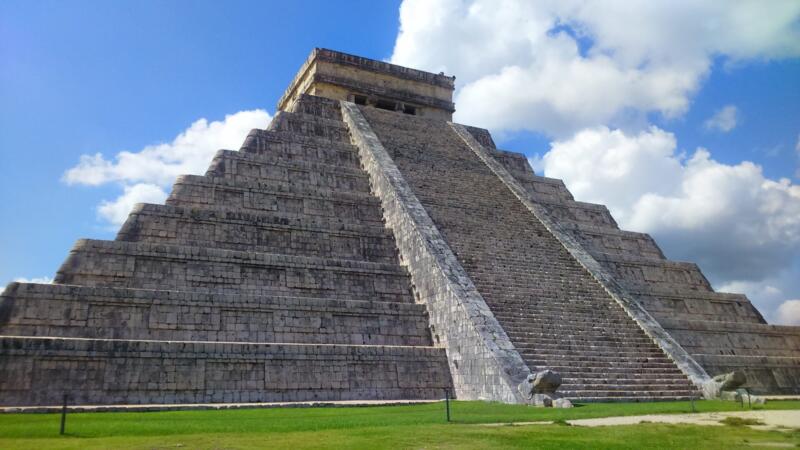

Imagine you are standing in front of a massive, modern pyramid-shaped glass pavilion. You know that the vertical height from the center floor straight up to the apex is exactly 40 feet, and the side walls slope down at a perfect 45° angle.
At exactly 3:00 PM, the sun hits the glass structure, casting a long, crisp shadow across the plaza. Standing at the very tip of that shadow and looking up at the apex, your line of sight forms a 30° angle with the ground.
The Question: Without pulling out a tape measure, a calculator, or a complex trigonometry textbook, can you calculate the exact length of the shadow from the center of the pyramid to its furthest tip?
It looks like a daunting calculation. But by the end of this quick post, you will be able to solve this giant architectural riddle in your head in under five seconds flat. To unlock the code, we have to start on the baseball diamond.
Many people don’t realize that a standard baseball diamond is actually a perfect geometric template.
The diamond is a square, and the distance between consecutive bases is exactly 90 feet. Imagine the second baseman catches a fly ball and wants to fire a throw all the way to home plate to make a spectacular out. How far must he throw the ball?
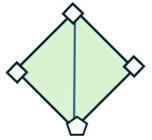
Because a square has 90° corners, drawing a line straight from second base to home plate cuts the infield perfectly in half, creating two 45°-45°-90° right triangles.
In mathematics, this is a “Special Right Triangle.” It follows an unbreakable shortcut rule for its side lengths. They are always in a ratio of :
Leg: Leg: Hypotenuse = x: x: x√2
Because both legs are 90 feet, the diagonal (the hypotenuse) is automatically 90√2 feet (about 127 feet). No intense algebra required. Just find the side, and attach √2.
Now that you know the 45°-45°-90° rule (x : x : x√2), let’s look at the second major shortcut in a mathematician’s toolkit: the 30°-60°-90° triangle. This triangle rules a different set of real-world dimensions, following a slightly different mental pattern:
Short Leg: Long Leg: Hypotenuse} = x : x√3: 2x
To see this shortcut in action, let’s look at two quick everyday puzzles:
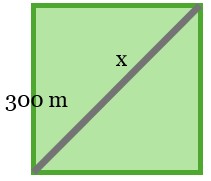
A downtown park is shaped like a perfect square. You walk along the perimeter from the Southwest corner to the Northwest corner, a distance of exactly 300 meters. Your friend walks diagonally across the lawn to the Northeast corner.
How far did your friend walk?
Answer: Using our baseball rule, your friend’s path is the hypotenuse of a 45°-45°-90° triangle, meaning they walked exactly 300√2 meters.
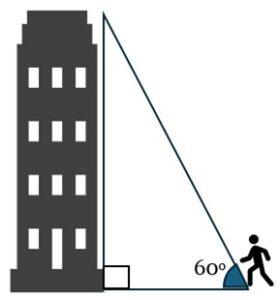 A drone clips a tree and lands on top of a flat warehouse roof. A technician stands on the ground, exactly 50 feet away from the base of the building, looking up at the drone at a 60° angle of elevation.
How tall is the building? How long is the rescue ladder the tech will use to reach the drone?
Answer: Because the ground and the wall form a 90° angle, this creates a 30°-60°-90° triangle. The ground distance (50 feet) is adjacent to the 60° angle, making it our short leg (x).

Now, let’s head back to our original 3:00 PM pyramid mystery. Armed with these two simple mental templates, we can dismantle the problem piece by piece.
Here it is again:
Imagine you are standing in front of a massive, modern pyramid-shaped glass pavilion. You know that the vertical height from the center floor straight up to the apex is exactly 40 feet, and the side walls slope down at a perfect 45° angle.
At exactly 3:00 PM, the sun hits the glass structure, casting a long, crisp shadow across the plaza. Standing at the very tip of that shadow and looking up at the apex, your line of sight forms a 30° angle with the ground.
The Question: Without pulling out a tape measure, a calculator, or a complex trigonometry textbook, can you calculate the exact length of the shadow from the center of the pyramid to its furthest tip?
The vertical height of the pyramid is 40 feet, and the outer walls slope at 45°. This creates an internal 45°-45°-90° triangle. Because the two legs of a 45°-45°-90° triangle are always congruent (completely equal), the distance along the floor from the exact center point to the outer edge of the wall is also exactly 40 feet.
Now look at the massive right triangle formed by the vertical height of the pyramid (40 feet), the flat ground, and the angle of the sun’s rays (30°).
Because the 40 feet height is directly opposite our 30° angle, it serves as the short leg (x) of our giant 30°-60°-90° triangle.
The total shadow length along the ground is the long leg of this triangle. According to our second shortcut rule, the long leg is always the short leg multiplied by √3 (x√3).
Without a single line of messy calculations, you have cracked the code: The total length of the shadow is exactly 40 √3 feet (approximately 69.3 feet!
When you learn to see the world through a mathematical lens, complex distances transform into elegant, predictable patterns. Whether you are throwing a baseball to home plate, mapping out a construction site, or calculating shadows on an architectural masterpiece, special right triangles give you the ultimate mental shorthand.

 Are you a student looking to conquer your next geometry exam, an educator looking for fresh ways to bring math to life, or a professional aiming to sharpen your analytical problem-solving skills?
We offer engaging, hands-on classes designed to take the intimidation out of STEM. We break down complex visual data, hidden geometric patterns, and logical frameworks into simple, actionable concepts you can apply anywhere.