


Use code NEWSTUDENT at checkout & save 20% off your first order (any number of lessons)
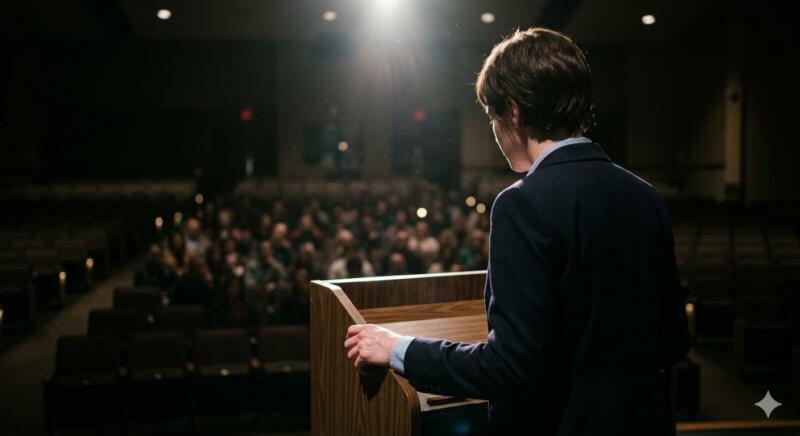

Your heart is a drum kit, your palms are a tropical rainforest, and your throat has suddenly decided to swallow a cactus. If that sounds familiar, you’re in good company—most people would rather face a swarm of angry bees than a microphone and an expectant audience. But the “fear of public speaking” isn’t an immovable character trait; it’s a physiological survival response that’s just a little bit confused about where it is. To turn that paralyzing anxiety into a powerful performance, you don’t need to get rid of the butterflies—you just need to teach them how to fly in formation.

QUESTION: I am dreading a work presentation I will have to make online in 2 weeks. What can you suggest to help me ease the pain of anxiety and fear that grips me each time I stand up to talk? Am I alone, or it this a common problem?
ANSWER: Rest assured that yes, this is a very familiar pattern for the majority of speakers. Statistically, you are certainly not alone. Approximately 77% of people experience fear of speaking, which can be managed with practice and mental reframing. 74% of Gen Z individuals say they fear public speaking — the highest rate among generational cohorts tracked. The good news: It responds faster to practice, than almost any other skill.
There’s a moment every speaker knows.

The room goes quiet. Eyes turn toward you. Your pulse spikes, your mouth goes dry, and every word you rehearsed seems to vanish. Whether you’re delivering a quarterly report, toasting the bride and groom, or speaking at a community event, public speaking has a way of making even the most capable people feel exposed. But here’s what the research shows: it’s one of the most learnable skills there is. The best way to overcome anxiety is to prepare, prepare, and prepare some more.
Approximately 77% of people experience fear of public speaking, which can be managed with practice and mental reframing. 74% of Gen Z individuals say they fear public speaking — the highest rate among generational cohorts tracked. The good news: it responds faster to practice than almost any other skill.
10 Tips to Overcome Your Fear of Public Speaking

Strong speeches don’t begin at the podium — they begin on the page. Even for a two-minute talk, a written outline forces clarity. It surfaces logical gaps, trims unnecessary tangents, and helps you identify your strongest points. Start with a clear beginning, middle, and end — even in bullet form.
Audiences form impressions fast. A flat opening means spending the rest of your speech trying to win back the attention you already lost. Open with a counterintuitive statistic that reframes a familiar idea, or pose a ‘what if’ question that creates immediate personal stakes. Starting with a story can also be a powerful way to capture your audience’s attention and enhance engagement, as stories make your message more memorable and relatable.
It’s tempting to adopt a more formal persona on stage. The instinct is understandable — it feels like armor. But audiences are remarkably good at detecting performance, and authenticity almost always lands better than polish.
 Reading your notes silently feels like preparation. It isn’t. The gap between how a speech reads and how it sounds when spoken aloud is wider than most people expect. Practice at full volume in front of a mirror or a trusted friend. Record yourself and watch for rushes and energy drops. Use chunking — practice each section individually, then stitch them together. Run through your opening at least five times separately; it sets the tone for everything that follows.
Pace is one of the most underrated tools in a speaker’s toolkit. Variation — not consistency — is the goal. Here is how to put it into practice:

What you wear affects how you feel — and dressing appropriately can help you feel comfortable and feel confident during your presentation. Choose clothes that are comfortable, appropriate for the setting, and give you a quiet sense of confidence. Observe the room’s standard, then add something distinctly yours. The goal is to feel like you belong there while projecting quiet authority. Avoid anything that will distract you physically — itchy fabric, ill-fitting shoes, or noisy accessories.
It’s completely normal to feel afraid before a public speaking engagement, and physical symptoms like having your palms sweat are common signs of anxiety. Mentally rehearsing worst-case scenarios can be one of the most calming things you do before a speech. When we fear something, we tend to overestimate how catastrophic it would be.
Where you practice and where you perform are often very different environments. An unfamiliar stage layout or unexpected acoustics can derail even a well-rehearsed speaker. Arrive early and walk the space before anyone else is in it. Take a few minutes to calm yourself and get comfortable in the environment, this can help manage anxiety and improve your performance.

The most memorable speeches don’t feel like monologues — they feel like exchanges. When the audience participates, they stop evaluating and start engaging.
Looking at the back wall is a common coping mechanism for nervous speakers. It feels safer — but it severs the connection that makes a speech land. Move your gaze naturally across the room, pausing on each person for a few seconds. Each person you land on will feel you’re speaking directly to them. Making eye contact and being aware of your body language can significantly influence how the audience feels and perceives you, helping to build rapport and trust.

Ultimately, public speaking is less about achieving a flawless performance and more about the value of the message you’re there to share. The next time you find yourself standing in the wings, remember that the audience isn’t there to watch you fail — they’re there to hear what you have to say. By embracing the nerves as a sign of energy rather than an omen of disaster, you reclaim your voice and your confidence. So, take that deep breath, step into the light, and start talking; the world is much more interested in your perspective than your perfection.
MYTUTORLESSON – ASK A QUESTION

On Sundays, Tuesdays, and Thursdays we invite you to “Ask MyTutorLesson” a question about how to improve your voice. Your question can be answered by our Voice and Speech Teacher, Bill Patti. Do you have a question? Please contact us at info@mytutorlesson.com.